

EN
At CHINAPLAS 2026 in Shanghai, in front of Lisong's PET injection molding machine booth, a Russian customer stood for a long time, his eyes fixed on the injection unit. He showed great interest in Lisong's system—the twin-screw configuration combined with a servo-motor-driven accumulation method. He kept asking: how exactly do these two components work, and how do they coordinate so seamlessly?
The answer lies precisely in the key to achieving ultra-short cycles, low energy consumption, and high-quality plastification in Lisong's PET preform system.
In a conventional single-screw injection molding machine, one screw handles plastification, metering, and injection, all in sequence. After injection, the screw must wait until the cooling phase ends before it can rotate to plastify the next batch of material. For PET thin-wall preforms with extremely short cooling times, the plastification time of a single screw becomes the bottleneck for the entire machine's speed, adding several seconds of idle time to each cycle.
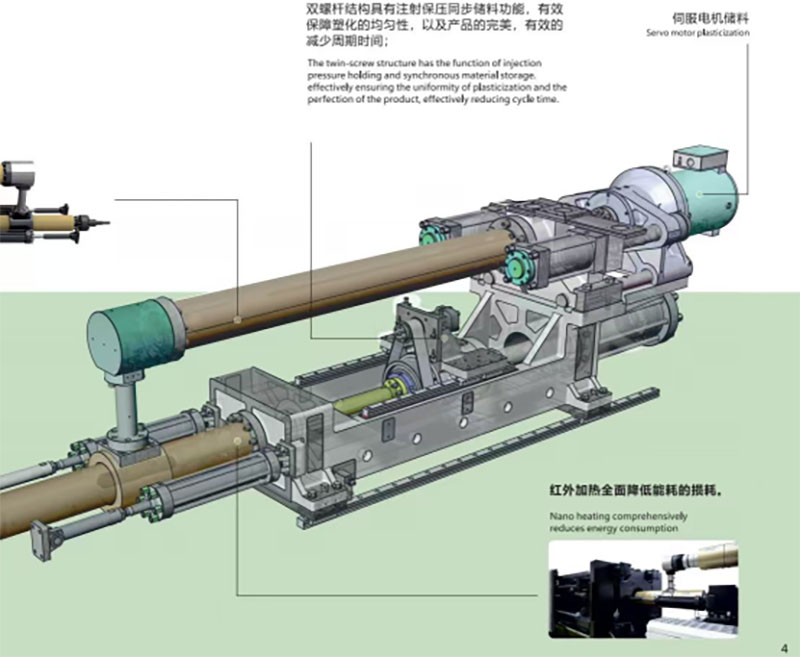
Lisong's independent twin-screw injection system completely separates plastification from injection. Two screws perform distinct roles: one is the plastification screw, dedicated to conveying, compressing, melting, and degassing the PET material; the other is the injection screw, responsible for accumulating the melt in the shooting chamber and then injecting it into the mold at high speed. The most ingenious part is that these two operations happen simultaneously—while the injection screw is injecting one shot of melt into the mold, the plastification screw is already preparing the material for the next shot. Plastification and injection have changed from a "serial" to a "parallel" process, directly eliminating waiting time in the cycle.
However, to fully unlock the potential of the twin-screw configuration, one more critical element is needed: accumulation. Accumulation is the process by which the injection screw refills the shooting chamber with melt after the injection stroke. If this step is slow, the advantage of parallel operation is compromised. Traditional hydraulic motor-driven accumulation suffers from response lag, imprecise speed control, and high energy consumption of the hydraulic system itself. Lisong's solution is to drive the accumulation screw directly with a servo motor—what they call "electric accumulation."
The benefits of electric accumulation are immediate. A servo motor responds much faster than a hydraulic system, with extremely sensitive start and stop capabilities, allowing the accumulation stroke to be completed in a shorter time. This means the injection screw can return to the ready-to-inject state more quickly, further shortening the overall cycle time. At the same time, the servo motor consumes electricity only when accumulation is needed, eliminating the standby energy losses of a hydraulic system and the throttling losses from hydraulic oil flow. Actual measurements show that energy consumption of electric accumulation is significantly lower than that of hydraulic accumulation. For companies engaged in long-term continuous production, this translates into considerable economic savings.
The plastification screw continuously melts the material, the injection screw driven by electric accumulation quickly fills with melt, and then delivers a high-speed injection—this combination allows Lisong's PET preform system to achieve impressive cycle times on the exhibition floor. What that Russian customer saw was not merely two screws and a motor, but a highly efficient, tightly coordinated cycle: uninterrupted plastification, fast and energy-saving accumulation, and stable, precise injection.
If the independent twin-screw solves the structural problem of "parallel operation," then electric accumulation is the final piece that truly accelerates this parallelism while reducing energy consumption. Working together, there is no waiting, no unnecessary energy waste. This is the deep technical foundation that made Lisong's PET injection molding machine attract global attention at CHINAPLAS 2026.
