

EN
Among the many technical paths available for injection molding machines, the choice of the clamping structure often determines how the equipment will fare over the next decade. For bucket-type products — particularly deep-cavity chemical buckets and paint buckets, which impose strict requirements on mold-closing precision — Lisong Injection Molding has taken a route that may appear conventional but is in fact profoundly far-sighted: mechanical direct-pressure clamping. Unlike the common toggle-type structure, the mechanical direct-pressure clamping system applies force directly to the platens through the main hydraulic cylinder, eliminating intermediate amplification and off-center loading as the clamping force is transmitted across the platens. The first direct benefit this brings is higher platen parallelism, with minimal deformation in the clamped state. With bucket molds, even a platen tilt too small to be seen by the naked eye can be magnified many times by a leverage effect at the bucket opening, resulting in uneven wall thickness or flash. Lisong's mechanical direct-pressure structure suppresses this deformation tendency right at the source of the force, keeping every mold opening and closing cycle within the ideal closure plane.
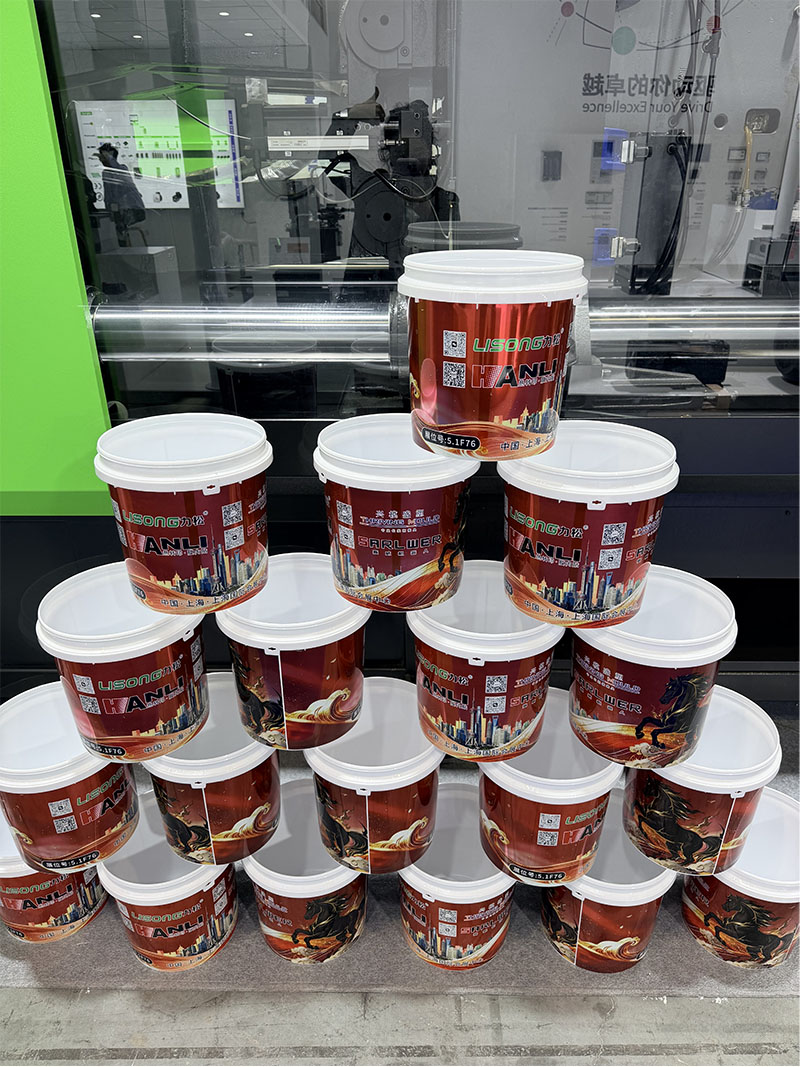
From a third-party perspective, the long-term value of this design is exactly what business owners tend to overlook most, yet it has the deepest impact. Wear on mold guide components and core shift caused by off-center loading are often the culprits that send a mold prematurely into its repair cycle. With Lisong's low-deformation platens paired with a high-rigidity frame, the actual service life of the mold can be longer, and the frequency of downtime for mold repairs is correspondingly lower. On a production line turning out thousands of buckets a day, having several fewer mold-repair shutdowns per month translates into very tangible profit.
Another noteworthy dimension is the broadening of the molding process window. Because of the high clamping rigidity, the actually required nominal clamping force can be smaller, meaning that under the same tonnage rating, Lisong's machines provide a more generous reserve against the mold-opening force. For customers, this translates into a larger clamping safety margin when processing high-viscosity materials or during low-temperature injection, making process set-up far less stressful. Choosing a machine is ultimately choosing its structural DNA, and with its mechanical direct-pressure design, Lisong's bucket-specific machines deliver an answer that can stand the test of time.
Clamping structure: The direct-pressure clamping structure of an injection molding machine is a clamping method in which the clamping force is provided directly by a hydraulic cylinder. Composed of platens, tie bars, cylinders, and a mold-height adjustment mechanism, it carries out the mold opening and closing actions of the machine.
Clamping force uniformity: The clamping force acts on the center of the platen through the cylinder, resulting in an even distribution of force. This effectively reduces flash and internal stress during molding and improves product quality.
High precision: Assisted by precision sensing technology, the system is able to quickly self-locate within the entire mold space, which is advantageous for precision molding.
Large mold opening stroke: The opening stroke is free from structural limitations, making this system suitable for the production of deep-cavity and multi-cavity molds.
