

EN
The demand for takeout containers, milk tea cups, food storage boxes, injection-molded containers, and medical thin-walled consumables continues to surge dramatically. However, most packaging manufacturers face the common challenge of increasing revenue without corresponding profit growth: lengthy molding cycles, uneven filling in multi-chamber molds, persistently high defect rates, high equipment energy consumption, and poor stability during prolonged continuous operation. As a sales professional with extensive experience in the thin-walled sector at Lison, after visiting thousands of injection molding plants, I have concluded that selecting the right specialized thin-walled injection molding machine is key to achieving significant profit differentiation among competitors.
Commercial injection molding machines are generally adequate for thick-walled products, but exhibit significant limitations when processing thin-walled parts with wall thicknesses of 0.35–1.0 mm: the cooling rate of molten material is extremely fast, resulting in insufficient injection speed on standard machines that frequently leads to material shortages, uneven wall thickness, and box warping or deformation; conventional curved-arm molds lack sufficient rigidity, suffering severe deformation under prolonged high-pressure locking conditions, which causes a sharp increase in defective products during multi-cavity mold production; the sequential operation design—where mold opening/closing, material melting, and ejection are executed separately—significantly restricts daily output per machine.
The Lison Thin-Wall Series injection molding machines are specifically developed for high-speed thin-walled part manufacturing, featuring comprehensive optimizations in structure, power systems, and control mechanisms that directly address key production challenges in the industry.
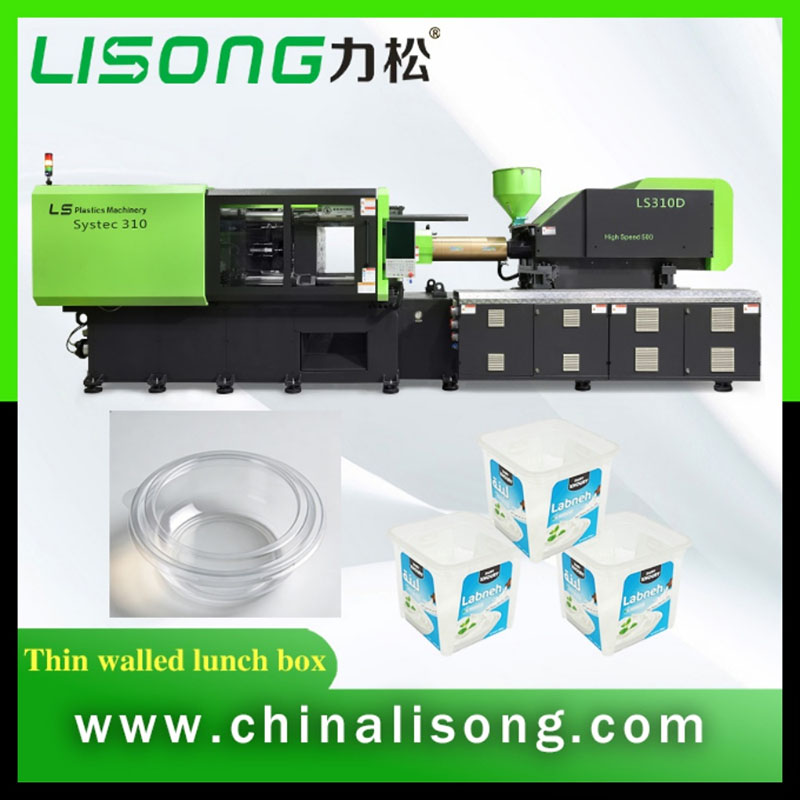
1.With ultra-high injection speed, it is perfectly suited for rapid filling of thin-walled products. Equipped with a standard ultra-high-speed injection unit capable of achieving maximum injection speeds exceeding 500 mm/s—significantly surpassing industry-standard models. Paired with a low-shear, high-mixing large L/D screw, it ensures uniform plasticization of PP and biodegradable PLA materials, instantly fills the mold cavity, and completely eliminates defects such as material shortages, flow marks, and weld lines in thin-walled products, maintaining wall thickness accuracy within ±0.02 mm. It effortlessly meets requirements for high-end food packaging and cosmetic thin-walled containers destined for international markets.
2.Featuring a high-rigidity, thickened mechanical direct-pressure clamping mechanism for stable 24-hour mass production. The system combines a thickened, high-rigidity template with a mechanical direct-pressure clamping structure that delivers uniform clamping force with minimal elastic deformation; even after prolonged high-pressure operation, the clamping force exhibits negligible attenuation, making it perfectly suitable for single-output, multi-cavity thin-walled molds. Standardly equipped with a high-speed servo proportional valve, it achieves millisecond-level mold opening/closing response and precise positioning, effectively protecting precision molds and significantly reducing maintenance costs. The entire unit's pull rods and templates are covered by a three-year warranty, enabling uninterrupted year-round factory production without operational concerns.
3.The system features synchronized compound movements, significantly reducing the molding cycle time. Equipped with a multi-servo independent hydraulic system, it enables simultaneous mold opening/closing, gel injection, and extrusion operations, eliminating the time-wasting step-by-step processes of traditional machines. For conventional PP fast-food boxes, the single-cycle compression time is reduced to 4–6 seconds; production capacity for milk tea cups and sauce containers increases by over 30%. Under identical plant conditions and workforce requirements, each machine achieves a daily output exceeding 100,000 units, eliminating the need for additional equipment or workforce expansion during peak order periods.
4.With comprehensive energy-saving configurations, long-term operation results in significant electricity savings. The system features a servo drive unit combined with an infrared nano-energy-efficient heating ring and closed-loop PID precision temperature control, achieving over 30% overall power efficiency. The built-in servo oil pump operates at constant temperature, offering low noise levels and halved oil leakage risk, thereby extending the service life of hydraulic components. Compared to conventional hydraulic presses, a 310-ton thin-walled press can save tens of thousands of kWh annually, directly boosting net profits in sustained production.
The models cover the entire tonnage range from 130T to 1050T, accommodating various applications—from small milk tea cups and test tube consumables to large-capacity preservation boxes and industrial thin-walled turnover containers. Options include hydraulic thin-walled machines or fully electric clean-thin-walled dual-line systems; high-speed hydraulic models are recommended for food packaging, while fully electric models are suitable for medical applications, cleanrooms, and premium cosmetic packaging, ensuring freedom from hydraulic oil contamination and compliance with ISO clean production standards.
As frontline sales professionals at Lison, we don't merely sell equipment; we provide comprehensive thin-walled molding solutions—including on-site mold testing and debugging, mold process optimization, automated production line integration, and lifelong technical support. Hundreds of thin-walled packaging manufacturers across the Yangtze River Delta and Pearl River Delta regions have adopted our systems for bulk procurement. Compared to conventional manual production facilities, using Lison's thin-walled machines reduces defect rates by 60% while significantly enhancing production capacity and overall profitability.
To observe machine operation firsthand, test molds, and obtain real-world data on product molding cycles and energy consumption, please contact me anytime for a customized one-on-one solution.
