

EN
For beverage packaging manufacturers, producing PET preforms for carbonated soft drinks (CSD) comes with strict quality benchmarks. Among these, controlling Acetaldehyde (AA) levels and maintaining intrinsic viscosity (IV) are the most critical yet challenging tasks.
High AA levels can alter the taste of the beverage, while a drop in viscosity weakens the bottle’s ability to withhold carbonation pressure. To meet international beverage standards, packaging factory owners must look beyond raw materials and focus on their machinery.
Here is a comprehensive guide on how advanced injection molding technology—specifically engineered by Lisong—helps you minimize AA levels and secure carbonated drink compliance.
1. The Root Cause: Why Do AA Levels Rise During PET Injection Molding?
PET (Polyethylene Terephthalate) is highly sensitive to heat and shear stress. When PET resin is melted inside the barrel, excessive temperatures, prolonged residence time, or aggressive mechanical shearing cause thermal degradation. This degradation produces Acetaldehyde (AA).
For carbonated drinks, high AA levels are a disaster, as they migrate into the liquid and ruin the flavor profile of pure water or sodas. To combat this, the injection molding machine must achieve high plasticization at the lowest possible thermal load.
2. Three Machinery Secrets to Lowering AA Levels and Locking IV Viscosity
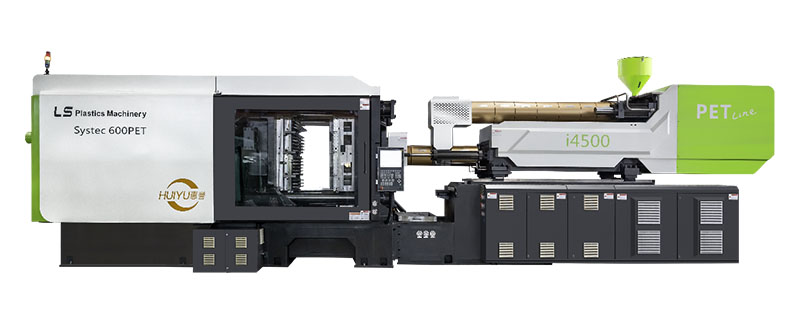
1)Low melting temperature, High-Plasticization Screw Design
Standard screws often require high rotational speeds to melt PET quickly, which generates massive shear heat and spikes AA levels. Lisong’s PET-specific specialized screw utilizes a low melting temperature, high-plasticization geometry.
The Benefit: Sufficient and homogeneous plasticization of PET resin can be guaranteed at a relatively low melt temperature, with neatly arranged molecular chains, high material crystallinity and much shorter melt residence time.
Matrix degradation and acetaldehyde (AA) formation are maintained at an extremely low level, enabling test results to easily comply with the stringent standards for carbonated beverage packaging.
2)Advanced PET-Specific Twin-Screw System
The plasticizing unit is the heart of AA control. Implementing a dedicated twin-screw structure brings game-changing advantages to PET preform production:
Superior Melt Homogeneity: It provides excellent mixing of color masterbatches and additives at lower melt temperatures, preventing localized overheating.
Reduced Hydrolysis: The twin-screw design optimizes venting and gas-release during the melting phase, protecting the PET resin from moisture-induced degradation, thus preserving the raw material's intrinsic viscosity (IV).
Fast & Precise Injection: Combined with rapid injection dynamics, the residence time of the molten polymer in the barrel is significantly shortened, giving AA zero time to form.
3)Infrared Nano Heating Coils for Precise Thermal Control
Traditional ceramic heating bands suffer from high thermal inertia and uneven heat distribution, leading to barrel "hot spots" that accelerate AA generation.
Lisong's standard Infrared Nano Heating Coils feature powerful thermal insulation. They deliver direct, uniform heating with instant response times. By eliminating temperature fluctuations in the barrel, the thermal degradation of PET is effectively suppressed, all while substantially lowering factory energy consumption.
3. Protecting Your Molds While Securing Quality
Achieving top-tier preform quality shouldn't come at the expense of your tooling. High-speed PET production requires robust mold protection.
Utilizing a Direct-Pressure Clamping Structure ensures that the clamping force is distributed with absolute uniformity across the platens, minimizing platen deformation and protecting high-cavity PET molds. Coupled with an ultra-sensitive low-pressure mold protection system—where the initial safety clamping force is only 1/30 of the high-pressure tonnage—the machine immediately halts if a misaligned preform is detected, saving your million-dollar molds from catastrophic damage.
H2: Conclusion
Minimizing AA levels in PET preforms requires a delicate balance of low temperature, low shear, and fast cycle times. Lisong’s specialized PET injection molding machines combine twin-screw precision, Low-RPM high-plasticization, and infrared nano heating to give beverage packagers the ultimate competitive edge.
