

EN
In the injection molding industry, companies often face a critical question: should they choose a high-speed injection molding machine or a standard injection molding machine?
In reality, there is no universally superior option. The right choice depends on factors such as product type, production volume requirements, investment budget, and long-term development plans. Understanding the differences between these two types of machines can help manufacturers make more informed decisions.
What Is a High-Speed Injection Molding Machine?
A high-speed injection molding machine achieves higher production efficiency by reducing cycle times for injection, plasticizing, mold opening, and mold closing processes. It is widely used in high-volume manufacturing applications, including: household products, food packaging containers, thin-wall products, disposable tableware, fast-moving consumer goods.
Compared with conventional machines, high-speed injection molding machines typically feature faster mold opening and closing speeds, higher injection speeds, greater plasticizing efficiency, optimized hydraulic and servo systems, and a machine structure designed for high-speed cyclic production.
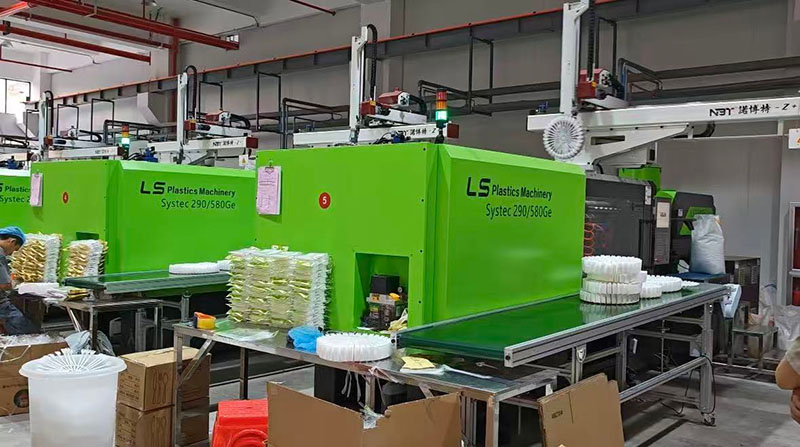
What Is a Standard Injection Molding Machine?
Standard injection molding machines offer strong versatility and material compatibility, making them suitable for a wide range of production requirements. They are commonly used for: automotive components, industrial parts, electrical products, engineering plastic products, medium- and low-volume production projects.
For manufacturers producing a variety of products with frequently changing production schedules, standard injection molding machines can provide stable and flexible production capabilities.
Key Differences Between High-Speed and Standard Injection Molding Machines
1. Production Efficiency
Production speed is the most noticeable difference between the two.
High-speed injection molding machines significantly reduce cycle times by increasing injection speed, shortening mold opening and closing times, and optimizing control systems. In industries such as household products, food containers, and thin-wall packaging, they can substantially increase daily output.
Although standard injection molding machines operate reliably, their cycle times are generally longer, making them more suitable for applications where production capacity is not the primary concern.
2. Injection Performance
High-speed injection molding machines typically utilize high-precision injection units, linear guide rails, and high-response servo control systems to improve injection speed and repeatability.
For thin-wall products, complex flow-path designs, or parts with strict dimensional requirements, faster injection response helps achieve more consistent molding quality.
3. Energy Consumption
With ongoing technological advancements, the gap in energy consumption between the two machine types is gradually narrowing.
Many high-speed injection molding machines now incorporate servo drive systems and energy-efficient heating technologies to improve energy utilization. Therefore, when selecting equipment, manufacturers should focus more on overall production efficiency rather than energy consumption alone.
4. Application Flexibility
Standard injection molding machines offer broader application flexibility and can process a wide variety of products.
High-speed injection molding machines, on the other hand, demonstrate greater advantages in high-volume production environments, particularly for manufacturers seeking maximum productivity and faster delivery times.
Why Are More Household Product Manufacturers Choosing High-Speed Injection Molding Machines?
As competition in the consumer goods market intensifies, brand owners are placing higher demands on delivery schedules and product quality.
As a result, manufacturers are increasingly focused on: equipment utilization rates, output per machine, delivery capability, production efficiency. For factories producing storage boxes, trash bins, laundry baskets, food containers, and other daily-use products, production efficiency directly impacts operational performance and capacity planning. This is one of the key reasons why high-speed injection molding machines are gaining widespread attention.
LISONG Household Products Pro Series
The LISONG Household Products Pro Series is specifically designed for household product manufacturing. It combines high-speed injection, precise control, and stable operation to meet the production requirements of various consumer goods.
For distributors, manufacturers, and equipment investors, a machine capable of producing a wider range of products can help improve equipment utilization and support future production expansion.
Conclusion
There is no absolute winner between high-speed injection molding machines and standard injection molding machines. The key is determining which option best aligns with a company’s production objectives.
If a manufacturer produces a diverse range of products with moderate output requirements, a standard injection molding machine remains a reliable choice. However, for companies focused on large-scale household product manufacturing and seeking shorter production cycles and higher efficiency, a high-speed injection molding machine offers significant advantages.
As the household products market continues to evolve, selecting equipment that aligns with long-term business strategies will become an increasingly important factor in enhancing competitiveness and achieving sustainable growth.
